Writing for the Supreme Court
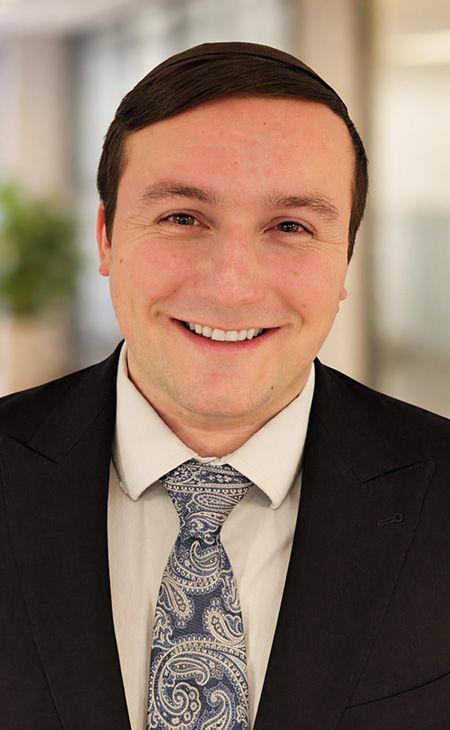
Shmuel Wyckoff '26
Shmuel Wyckoff ’26 is honing his legal writing skills through Chicago-Kent's intensive, four-semester writing program and hands-on appellate internships that have him drafting briefs for real cases.
“The academics at Chicago-Kent College of Law are fantastic,” says Shmuel Wyckoff ’26. “The professors are all experts in their fields, and they impart so much wisdom beyond the course subject material.”
Wyckoff wants to become the best legal writer he can be. In that journey, he knew exactly which law school could help him achieve his goal.
“I especially appreciate that Chicago-Kent’s legal writing program has students writing a full appellate brief in their second semester and spans four full semesters of school,” he says. “Legal writing is the skill that I have chosen to focus on most throughout my law school experience, and Chicago-Kent’s legal writing professors have helped me sharpen and develop my writing.”
And Wyckoff has pursued internships that have helped him hone his legal writing skills.
His first was at the Illinois State’s Attorneys Appellate Prosecutor, which fueled his passion for appellate practice. He returned there for a second internship during his third year and is now independently writing briefs in criminal appeals.
“My internship experiences have prepared me to hit the ground running when I become a lawyer,” he says. “I feel that I’ve gotten to start building a foundation in core legal skills that all attorneys need.”
His internship with the Civil Appeals Division of the Office of the Illinois Attorney General threw him headfirst into one of the biggest lawsuits in the country, Trump V. Illinois. The Illinois attorney general sued President Donald Trump to prevent him from federalizing the Illinois National Guard. Eventually, it went all the way to the United States Supreme Court, where the federal government relied on a statute that allows the president to federalize the national guard when “regular forces” can’t maintain order. The federal government argued that “regular forces” referred to any federal law enforcement agency.
“The state’s position was that ‘regular forces’ refers to the military,” says Wyckoff. “I did a project sifting through old statutes to prove that the historical use of that term refers to the military.”
The State of Illinois prevailed at the U.S. Supreme Court, halting the national guard rollout in the city of Chicago.
Wyckoff also spent a summer working for the federal government as an intern for the U.S. Attorney’s Office for the Central District of California in Los Angeles.
“I got to see firsthand how federal prosecutors work up a case and prepare witnesses,” says Wyckoff. “One of the highlights of that summer was getting to speak in court. I represented the government in dozens of detention hearings and a change of plea hearing.”
At Chicago-Kent, he leads the Federalist Society, hosting debates and inviting guest speakers throughout the year.
“My goal is to foster free speech, critical thinking, and civilized debate on campus,” he says. “All kinds of diversity are important, including intellectual diversity.”