Migrant Mercy: Pedro Gerson Awarded Prize for Immigration Law Scholarship
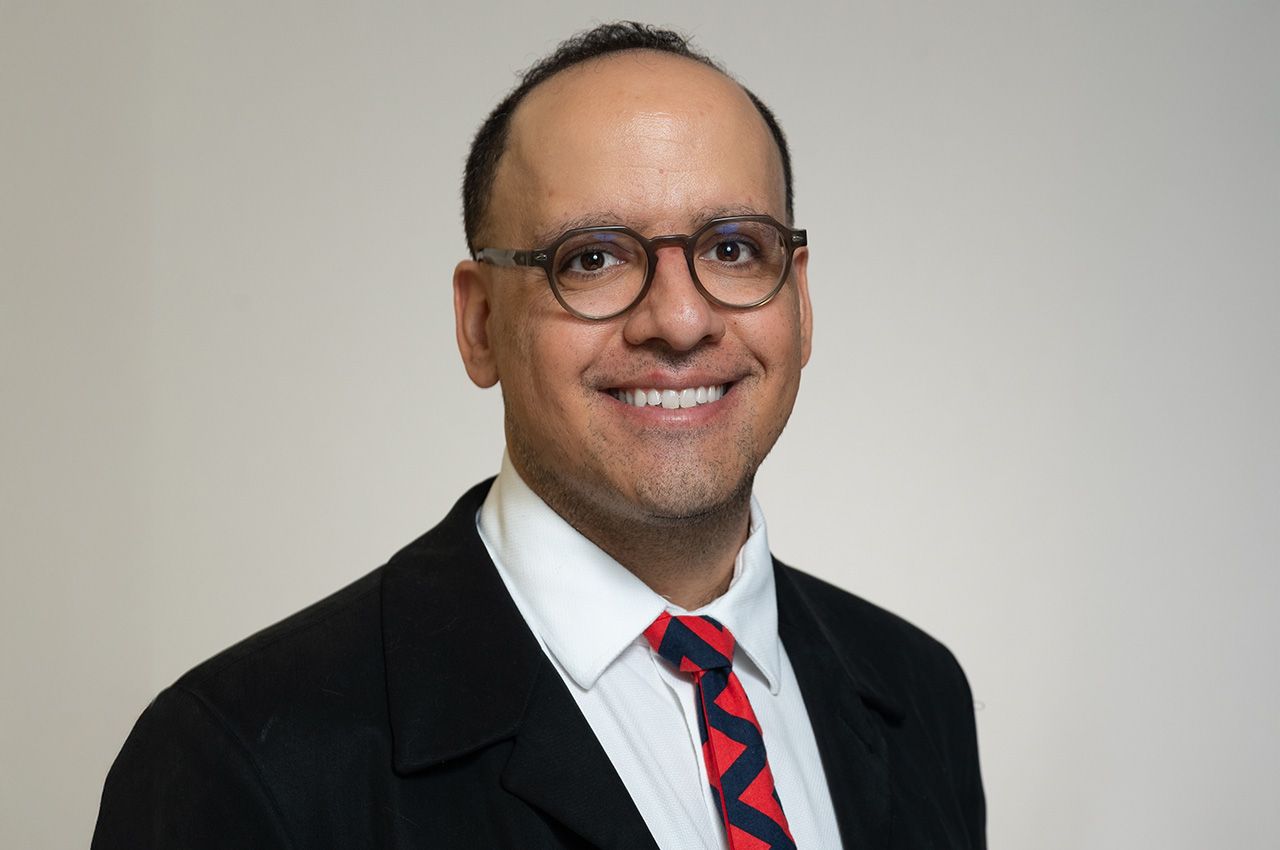
“I was very surprised,” says Chicago-Kent College of Law Assistant Professor of Law Pedro Gerson. “I think more than anything, it’s the fact that the ideas in the paper resonated with someone.”
Gerson is the inaugural winner of the Mother Cabrini Mercy Prize, a prize “given for excellence in immigration scholarship and advocacy,” according to the prize’s website. An immigrant to the United States from Italy, Saint Frances Xavier Cabrini was recognized as the patron saint of immigrants by the Vatican in 1950.
Gerson’s winning paper, “Decriminalizing Migrant Smuggling,” will be published in the Georgetown Immigration Law Journal.
Gerson doesn’t believe that people who are part of mass migrations want to move, but instead are forced to leave their homes due to economic, political, or other reasons.
“We’re talking about displacement,” he says. “These displaced people are coming to the [United States] for a number of reasons, but one of the most important ones is because there is a demand for them here, whether it is humanitarian or not.”
When the demand for migrants grows quicker than the legal means for those migrants to legally enter their destination countries, Gerson argues that smugglers will naturally step in to fill that need.
“That creates basically a black market, and in that black market, of course, people are abused and can be abused,” says Gerson.
However, Gerson makes a distinction between smuggling and trafficking. People who are being smuggled are doing so voluntarily, but the illegal nature of the industry makes it easier for bad actors to abuse desperate people.
“If you want to protect people from that abuse, there are statues that target that behavior,” says Gerson. “Fraud, physical and sexual assault, kidnapping, whatever harm migrants may face, if the U.S. government cares about protecting them from the smugglers, they can target the smugglers’ behavior rather than the act of smuggling.”
Gerson also uses the paper to dispel common myths about smuggling—primarily that it’s a complex, highly sophisticated transnational criminal organization.
“Human smuggling doesn't look like that at all,” says Gerson. “Most smugglers are destitute. Many of them are migrants themselves who have either failed or decided this was a better route or succeeded and then were deported. It’s not a sophisticated criminal enterprise. People are being smuggled by people that basically were or are very much like them. And if we want to end that, we need to create more open paths to migrate.”
According to Gerson, as long as there is a demand for migrants, people will find a way to cross the border.
“There are very strong information networks,” he says. “If people hear in their information networks, ‘Don't come because there’s nothing for you here,’ people will stop coming relatively quickly.”
As the winner of the Mother Cabrini Mercy Prize, Gerson received a cash prize, most of which he plans to donate. To find a suitable location, he turned to his students.
“They have suggested some places that they work with and volunteer,” he says. “I think by keeping it close—an organization that works in Chicago on the ground with immigrants, where some of our students work, the students who have taken my courses and discussed these things with me—feels like the right place to donate.”