
Chicago-Kent Professor Daniel Martin Katz Co-Authors New Book on the History, Design and Governance of AI Agents
“We are moving into this world of increasingly autonomous systems operating on our behalf,” says Professor Daniel Martin Katz. “People need to know what that means.”
Katz, with co-authors Michael Bommarito and Jillian Bommarito, has released his latest book, Agentic AI in Law and Finance: Navigating a New Era of Autonomous Systems. It breaks down how lawyers and people in the business world can use artificial intelligence to help with their tasks.
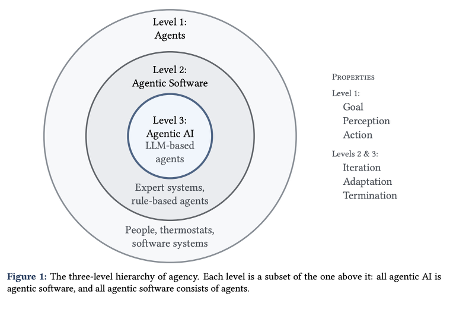
“The book is broken into three parts,” says Katz. “We introduce the idea of what AI agents are in part one. The middle part is how to design an agent, and the last part is how to govern. When you have a system that’s acting autonomously, you want to have controls over it and the ability to oversee what the agent does.”
This book came together much more quickly than Katz’s past books—mostly because he used AI to help.
“We are very upfront about this with a disclaimer in the book intro, this is a book about AI written in conjunction with AI,” Katz explains. “One of the points here is that we’re able to do a lot more in this world of AI. Personally, I have edited one book in the last five years, and we were able to do this in a few months while doing many other things. I do think that sort of speaks to the art of the possible here.”
Katz and his co-authors outlined the ideas, drafted aspects of the text, had to rewrite some of what the AI agent wrote, but the technology certainly helped get the juices flowing.
“I don’t think that is indicative of a world where robots take over everything because we still had to undertake a significant amount of work,” he says. “We had to edit it. We added a lot of content, but it gave us a sparring partner to move things along faster.”
A bound copy of the book is available on Amazon, but Katz is also offering a digital version for free on SSRN.
“My co-authors and I wanted to get this content to the largest number of people as possible, and the easiest way is to not charge,” he says. “We’re in the academy here—our job is to disseminate knowledge.”
Katz also recognizes that AI is changing society, and the fields of business and law in particular, more quickly than most people can keep up. He thinks that sharing this knowledge with people is essential.
“A lot of organizations and individuals do not have a lot of experience with this idea,” says Katz. “We need to have laws and rules of the road for this whole transformation in society more broadly. Therefore, lawyers need to know more about it. The public needs to know more about it too.”
In addition to this recent book, Katz is a global thought leader and scholar working at the intersection of law and technology. In 2025 the Financial Times named Katz as one of the “Top 20 Legal Market Shapers of the Past 20 Years” for both his academic and commercial work advancing the state of AI in the law.
His paper, “GPT Passes the Bar Exam”—co-written with 273 Ventures co-founder Michael Bommarito as well as Shang Gao (Casetext) and Pablo David Arredondo (Casetext)—was the most downloaded and cited paper of the year in the Philosophical Transactions of the Royal Society A in 2024.
In 2025 he was the co-author of several papers applying AI methods to contract drafting and analysis, including “Software Engineering Meets Legal Texts: LLMs for Auto Detection of Contract Smells,” “LLM as a Judge for Evaluating Contract Graphs: Multi-Judge Benchmarking and Agentic Uncertainty-Aware Refinement,” as well as “GRAPH-GRPO-LEX: Legal Contracts Graph Modeling via Reinforcement Learning with Group Relative Policy Optimization,” authored with a team which includes Moriya Dechtiar and Hongming Wang of Harvard University and Sylvain Jaume of MIT.