Learning by Teaching: Law Students Turn Celebrity Legal Battles into Civics Lessons

“There is a very big difference between understanding something and understanding it well enough to explain it to someone else ,” says Cody Clark ’26, paraphrasing Albert Einstein.
Clark is one of the Chicago-Kent College of Law students who developed lesson plans to help middle school and high school teachers teach their students about the law. The lesson plans examine high-profile court cases, such as Depp v. Heard, which saw actor Johnny Depp sue his ex-wife, Amber Heard, for defamation after she claimed that he abused her during their marriage.
“There are a lot of cases around things such as a farmer’s cows, a farm sale from 1954, or where somebody found some logs on a river in North Carolina in 1840 that we study, but those can be a little dry,” says Clark.
The lesson plans that the Chicago-Kent students produced were part of the class of 2026 honors scholars’ law and policy project. The honors scholars program provides full-tuition scholarships at Chicago-Kent for extraordinarily talented and motivated students who have the potential to influence the profession’s direction. It includes opportunities for students to explore numerous aspects of legal practice and public policy through close collaboration with Chicago-Kent faculty members.
Several of the 2026 honors scholars had educational backgrounds, and Clark’s own wife is an assistant principal within Chicago Public Schools, so the Chicago-Kent students decided to use their collective passion to help younger learners to discover the law. The group created dozens of lesson plans, eventually perfecting four for presentation. In addition to the Depp V. Heard lesson plan, there’s an option to teach non-disclosure agreements by examining the breakup of country music star Zach Bryan and podcast host Brianna LaPaglia; explore copyright by examining Luke Combs’s cover of Tracy Chapman’s song “Fast Car;” or use Michael Jackson’s famous moonwalk shoes as an example to teach about patent law.
Developing the lesson plans ended up teaching the students even more about the law.
“After having done two years of law school, I like to think that I understand patent or copyright law,” says Clark. “Explaining introductory patent law to someone that knows absolutely nothing about patent law should be easy; in retrospect, it turns out it was pretty difficult.”
The students made the lesson plans publicly available to teachers through Chicago-Kent’s Constitutional Democracy Project, an endeavor that offers non-partisan, high-quality, hands-on civics education programs and teaching materials focused on the United States Constitution, law, and policy for middle school and high school students and their teachers.
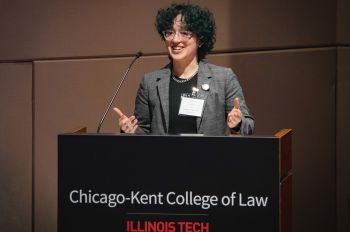
On October 31, 2025, Clark presented the lesson plans to teachers at the 2025 Conference for Teachers in Civics, Law, and Government.
“It certainly felt weird to be a non-teacher with no education experience modeling to teachers,” says Clark. “It’s a good way to stay connected with the community and to give back a little bit.”
Clark first heard about the Constitutional Democracy Project when Chicago-Kent Professor Harold J. Krent, the honors scholars’ adviser, suggested that they donate their completed lesson plans to the project. Clark hopes that in the future, students will get more involved.
“I wish students as a whole were doing more things with the project,” he says. “I don’t think many Chicago-Kent students know about it.”